03 Core service
Neurological Rehabilitation
Rehabilitation for people living with neurological conditions or injuries that affect movement, balance, coordination, communication, thinking or everyday independence.
Assessment-led · goal-based
About this service
What neurological rehabilitation covers
Neurological rehabilitation is shaped around the person — their abilities, goals, medical status and home. It may involve coordinated input from several rehabilitation professionals and close work with caregivers. The diagnosis alone never decides the programme; an individual assessment does.
Pathways
Care tailored to your situation
Support for movement, balance and daily function after stroke.
Function-focused support for mobility, balance and everyday activities.
Rehabilitation that adapts to changing symptoms, fatigue and needs.
Support for mobility, transfers, positioning and independence, matched to injury level and medical needs.
Rehabilitation for physical, cognitive and functional difficulties after brain injury.
Support for function and movement affected by nerve injury.
Conditions covered
- Stroke
- Parkinson's disease
- Multiple sclerosis
- Spinal cord injury
- Traumatic brain injury
- Peripheral nerve injuries
Difficulties you may recognise
- Weakness or altered movement
- Balance problems and risk of falls
- Difficulty walking or transferring
- Reduced hand function
- Fatigue
- Coordination difficulties
- Challenges with self-care, communication or memory
Not a diagnostic checklist — everyday signs that rehabilitation may help.
Rehabilitation goals
- Improve or maintain safe mobility
- Greater independence in daily activities
- Better balance, strength and coordination where possible
- Train caregivers in safe assistance
- Adapt tasks and the home environment
- Support participation and quality of life as needs change
We set goals with you. No programme can guarantee an outcome.
Assessment
How we assess you
We review the diagnosis, onset, medical stability, medicines and specialist advice; understand previous and current function; and assess movement, tone, strength, balance, transfers, walking, arm and hand use and daily activities as appropriate. We consider thinking, communication, fatigue and caregiver support, then set measurable goals and a coordinated plan.
We review your request and check for anything that needs urgent medical attention.
At home or online — history, function, and what matters to you.
Measurable goals, session frequency and a home programme.
Regular outcome checks; the plan is updated as you improve.
Care modes
Home visit or online?
Home rehabilitation
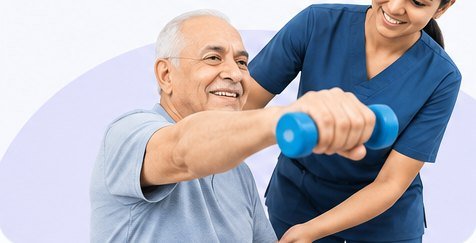
Home visits are often the best way to practise transfers, walking and daily tasks in the real home environment.
Online consultation
Online consultations can support education, caregiver guidance and selected follow-ups.
Not every assessment or hands-on treatment is suitable online — your clinician will advise.
Can rehabilitation help after a stroke?
Yes — rehabilitation supports functional recovery, adaptation and independence. The plan and the pace of progress are different for everyone.
Can a therapist visit someone who is bed-bound?
A home assessment may be possible if the person is medically stable and we can safely meet their needs.
Should a caregiver attend sessions?
Usually it helps — especially when the person needs assistance or practice between sessions.
Can neurological rehabilitation be done online?
Some education and follow-up can be online; hands-on assessment and treatment may need an in-person visit.
Assessment
Ready to start neurological rehabilitation?
Request a neurological rehabilitation assessment. Share the diagnosis, current abilities and any medical or therapy reports.